Don't look back
on black leather jackets
everywhere for miles around.
Time to take the highway
off into the wild (Brando).
Wind up, once airborne, any cause will do.
Poor yellow jacket he's done
gone for fear of losing his sting.
Working class heroes seek
shelter from the edgy
nest of aging bikers (McQueen).
Homosapiens don dark hide,
tanned for a gay display,
a common fabric, of masculinity.
Even queens swing the
hetero leather road sign and
wear powerful dark
sunglasses on a rainy day
(or someother sad occasion).
Who knows when the boredom
of Mr. and Mrs. Smith’s (Pitt and Jolie)
will become as mutually threatening
as a modified ovipositor.
In the meantime, show solidarity.
Any cause will do.
When anti-heros pay tribute
there is another biker
in a black leather jacket
to boot and ride back.
Remember: you were first.
Tuesday, December 2, 2008

Monday, November 24, 2008
Foul play?

Portrait of a turkey
Thanksgiving Day 2008
Dear John (Cleese),
Re: "Feeding the beast".
Funny or tragic as your case may be, I'm glad to hear you say that you are happy (despite or due to your divorce).
An insight into the nature of capitalism (as opposed to the nature of love) is that wherever there is a breadwinner there must be a breadloser.
Turkey lovers unite and give thanks
for the sage
in the stuffing.
Mine shaft - November 23, 1008
I was raised in a dark forest, though I’m not quite sure anything but trees could ever really grow up around here where the task of the miner was to dig down, deeper. And who could ever grow tall enough to absorb light through such dense clusters of pine needles? Even the trunks of the tallest, cleanest and straightest pines were valuable only to the extent that they could be hollowed into wooden pipelines, destined to redirect the relentless trickle and flow out of the tunnels. Buckets and people were forever being dented, dropped and dragged day after day through the cold and damp underground. Most of the people who managed to live long enough to see the light were soon lowered into the dark corridors of these same mines, to fire, crack, pick, dig, haul and hoist ore into carts and up pulleys that ran parallel to pump lines. I suppose growth in this neck of the woods was never really intended to be equated with height, with grain or vegetables or trees, much less with how tall or wise a human being became, but with the weight of the ore, the depth of a shaft or the height of a mound of discarded stones. A heavy measure of fortune and misfortune.
Nowadays, pine trees seem to bow to the monumental ground swells that mark the depths of these woods, as though honoring the memory of a Viking chieftan. Draped with lichens and moss, and powdered by an occasional snowfall, the stones of these tumuli give witness to the iron filings and the magnetism that iron ore once attracted to this district. All the iron ore that laced the rock from Skottvång Mine went to the nearby cannon forge. Both the adjacent gun and powder factories exist yet, manufacturing, marketing and selling what they have renamed 'survivability'. It is also the privilege of centuries of Swedish monarchs to lie in Stockholm under the slender latticed spire wrought from Skottvång ore.
People who hike in summer along the recreational nature trail that passes through this terrain – along the repetitive traces of rotted railway sleepers – are more stimuated than misled by their daydreams. They can easily imagine grave settings from the late Iron Age and pittoresque forest meres. A few know that they are passing reflections at the entrances to deep waterlogged shafts, where human beings were lowered to slither and crawl only a generation or two ago.
The story I must tell begins here in an abandoned mining district in central Sweden. The terror and cruelty of my story is not easy to tell, because somehow I’ve always believed, like everyone else around here, that everything that I have witnessed in these parts, every fortune or misfortune, is a secret that I have promised to keep. Now I know that it is mine and that I am free to build the imaginary walls needed to reinforce my safe passage, to inject my antidote into sluggish veins and thus become the author of myself.
Nowadays, pine trees seem to bow to the monumental ground swells that mark the depths of these woods, as though honoring the memory of a Viking chieftan. Draped with lichens and moss, and powdered by an occasional snowfall, the stones of these tumuli give witness to the iron filings and the magnetism that iron ore once attracted to this district. All the iron ore that laced the rock from Skottvång Mine went to the nearby cannon forge. Both the adjacent gun and powder factories exist yet, manufacturing, marketing and selling what they have renamed 'survivability'. It is also the privilege of centuries of Swedish monarchs to lie in Stockholm under the slender latticed spire wrought from Skottvång ore.
People who hike in summer along the recreational nature trail that passes through this terrain – along the repetitive traces of rotted railway sleepers – are more stimuated than misled by their daydreams. They can easily imagine grave settings from the late Iron Age and pittoresque forest meres. A few know that they are passing reflections at the entrances to deep waterlogged shafts, where human beings were lowered to slither and crawl only a generation or two ago.
The story I must tell begins here in an abandoned mining district in central Sweden. The terror and cruelty of my story is not easy to tell, because somehow I’ve always believed, like everyone else around here, that everything that I have witnessed in these parts, every fortune or misfortune, is a secret that I have promised to keep. Now I know that it is mine and that I am free to build the imaginary walls needed to reinforce my safe passage, to inject my antidote into sluggish veins and thus become the author of myself.
Saturday, November 1, 2008
November 1, 2008
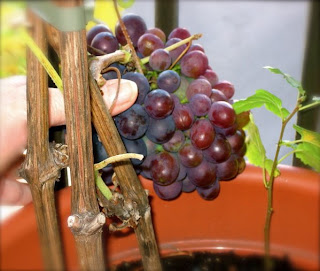
In dazzling sunlight today, M and I made our final preparations for the winter - planted more bulbs, took up the last root vegetables, raked maple leaves, cut back the climbing vines and still flowering roses. Then there was the savour of homegrown Jerusalem artichokes in a delicate creamed soup. And from a pot on my balcony: behold the ripe fruit!
Monday, October 13, 2008
Too easily burned?
Off in the distance, I have just caught sight of some people on this otherwise deserted beach. To my delight there’s a little girl who looks to be around my age. She is standing on a big towel in front of a weathered grey bathhouse. Perhaps she is someone who would like to play with me? As I begin running towards her, she looks familiar. I can see that she is bending over to pick up a T-shirt. Then suddenly I realize that she must be me, since I am the only 10-year-old redhead I’ve ever known who is so easily burned that she has to wear a long-sleeved T-shirt on a hot day like this.
What a wonderful opportunity, then, to watch myself as a child, lost in play on a clear day with such strong reflections from the sea. The trouble is, as I zoom in to observe her more closely, her face dissolves behind a coarse grain of fabric. She seems to be stuck, at a loss to get into or out of her T-shirt, and I awake in a panic. Will I never be able to look back and see her again, up closely? Is this the only way to protect sensitive skin from solar radiation, or to protect one's integrity from exploitation by an intrusive lens. Shame on me and the old woman on the Indian reservation?
What a wonderful opportunity, then, to watch myself as a child, lost in play on a clear day with such strong reflections from the sea. The trouble is, as I zoom in to observe her more closely, her face dissolves behind a coarse grain of fabric. She seems to be stuck, at a loss to get into or out of her T-shirt, and I awake in a panic. Will I never be able to look back and see her again, up closely? Is this the only way to protect sensitive skin from solar radiation, or to protect one's integrity from exploitation by an intrusive lens. Shame on me and the old woman on the Indian reservation?
Sunday, October 12, 2008
The Suwa Maru

Did we have a special beach in mind? Not even mother Anne seemed to know where we were going, though we could see water everywhere. Groping in broad daylight, I followed a path through the Enen-kio brush toward a bank of the turquoise lagoon. I think I was following mother Anne, hoping that a dip would soon restore me the way it usually did. I was quickly let down. The beach proved to be uninviting, full of pebbles that were hard on my feet, and I had been warned to watch out for the poisonous coral along the waters edge. Even a rusty old diving board, constructed for the recreation of soldiers, did not coax me to play, but served only as a monument of isolation and abandonment to bully and mock whomever might happen to see it. Thus my obligatory descent into the lagoon was not at all refreshing, but tepid as the breeding ground for all sorts of invisible creatures.
I must have been perfectly exhausted that day (or was it really night?), and lost my appetite when I vomited onboard, because I cannot remember any of the meals we ate on the island or attempts to fall asleep in the metal hut.
The next day, dad asked me if I wanted to survey the island with him. Perhaps he asked other family members too, but I was apparently the most eager to join him on this excursion. Given my lingering disappointment from the day before, coupled with the fact that I was feeling better, I wanted to go somewhere else. Dad seemed keen on showing me a place where he had been before, or perhaps he simply wanted to share his innate need to reconnoiter the unfamilar, a war relic, a neglected springboard between the US and the Far East. We were there for a purpose, though it was not a place either of us would have chosen to visit. We were both taking orders. We walked along the outer shores of the atoll, where the waves lapped, and the breeze was more refreshing. A corroded shipwreck rose like the tail end of some giant seabird bent on obtaining some sustenance for survival.
Dad offered an explanation: “Her name was "Suwa Maru".
“Sue was…what?”, I asked.
“Suwa Maru. She was a merchant vessel that tried to pass the American block in 1943, World War II, and was hit by torpedoes. The captain beached her here, before she sank.”
“Oh”.
We continued along the south shore in silence until we arrived at the airstrip, where we turned back toward the huts.
Saturday, October 11, 2008
Tomorrow is another day
I have been told since that the reason I had seen flames licking the wings of our propeller plane was not because the engines had caught fire, but because fuel was being dumped to prepare for our unplanned landing on Wake – or Enen-kio as it was called by pre-European travelers after the orange-blossoming shrub which grows on this otherwise rather barren atoll. The Japanese who later occupied the island called it Otori-Shima or "Bird Island" for its birdlike shape.
We landed safely on the Wake airstrip. As we descended the ramp into the suffocating heat, I hoped that just setting foot on land would restore my balance. I could see a low control tower at the end of the strip, and a couple of GIs to the right who were prepared to guide us along the road to our accommodations in a couple of corrugated metal quansit huts. While we walked together as a family, mom, my sister and I were escorted to one hut, and dad and my brothers to the other. In the tumult of our separation, I could tell that dad felt slightly uncomfortable too. His look seemed to say: “be a good sport, tomorrow is another day.”
In rituals of the ancient Marshalles islands, it is claimed that tribal chiefs were installed by carving a mark into their skin with a sharp human bone. The latter required human sacrifice. A man could, however, save himself from being sacrificed if he could brave the journey to the Enen-kio atoll and obtain a wing bone from a large seabird that nested on the atoll. Could that have been the albatross of which Samuel Taylor Coleridge speaks in the Rime of the Ancient Mariner?
Entering the huge metal hut, I was overwhelmed by the pungent odor of all the army green woolen blankets spread neatly over each of the cots. I trudged down the aisle to where mom had laid claim to three. There seemed to be some sort of unwritten code that we should occupy beds at a respectful distance from the other women and children on the flight. Though I was tired, I didn’t feel like lying down on the rough blankets.
When our luggage was deposited alongside our beds, Mom tried to cheer me up by suggesting that we go for a swim. And so I eventually mustered up the energy to rummage through a bag to find my bathing suit. It seemed to take forever to find my suit and change, though perhaps it wouldn’t have been easier had the space felt more intimate.
In October of 1568, a Spanish explorer, Álvaro de Mendaña de Neyra discovered "a low barren island, judged to be eight leagues circumference," to which he gave the name of "San Francisco”. While it is believed that the island that he discovered was today’s Wake, named after the British trader William Wake who visited the atoll in 1796, the land that I set foot on at age 10, in August 1957, was nothing even remotely like the San Francisco, much less the Ocean Beach, that I had just left.
We landed safely on the Wake airstrip. As we descended the ramp into the suffocating heat, I hoped that just setting foot on land would restore my balance. I could see a low control tower at the end of the strip, and a couple of GIs to the right who were prepared to guide us along the road to our accommodations in a couple of corrugated metal quansit huts. While we walked together as a family, mom, my sister and I were escorted to one hut, and dad and my brothers to the other. In the tumult of our separation, I could tell that dad felt slightly uncomfortable too. His look seemed to say: “be a good sport, tomorrow is another day.”
In rituals of the ancient Marshalles islands, it is claimed that tribal chiefs were installed by carving a mark into their skin with a sharp human bone. The latter required human sacrifice. A man could, however, save himself from being sacrificed if he could brave the journey to the Enen-kio atoll and obtain a wing bone from a large seabird that nested on the atoll. Could that have been the albatross of which Samuel Taylor Coleridge speaks in the Rime of the Ancient Mariner?
Entering the huge metal hut, I was overwhelmed by the pungent odor of all the army green woolen blankets spread neatly over each of the cots. I trudged down the aisle to where mom had laid claim to three. There seemed to be some sort of unwritten code that we should occupy beds at a respectful distance from the other women and children on the flight. Though I was tired, I didn’t feel like lying down on the rough blankets.
When our luggage was deposited alongside our beds, Mom tried to cheer me up by suggesting that we go for a swim. And so I eventually mustered up the energy to rummage through a bag to find my bathing suit. It seemed to take forever to find my suit and change, though perhaps it wouldn’t have been easier had the space felt more intimate.
In October of 1568, a Spanish explorer, Álvaro de Mendaña de Neyra discovered "a low barren island, judged to be eight leagues circumference," to which he gave the name of "San Francisco”. While it is believed that the island that he discovered was today’s Wake, named after the British trader William Wake who visited the atoll in 1796, the land that I set foot on at age 10, in August 1957, was nothing even remotely like the San Francisco, much less the Ocean Beach, that I had just left.
Subscribe to:
Posts (Atom)
